

















 0
0
Wheat yields have the potential to increase
By 2035, yields of barley and maize are projected to remain stable compared with 2023-2025, while total wheat yields could return to higher 2013-2015 levels, with growth of 0.1% per year. Any negative effects on yields in the coming years are likely to come from increasingly frequent extreme weather events,
the expansion of land area cultivated with lower yielding practices (e.g. organic farming), and negative impacts due to the affordability and availability of inputs. Nitrogen fertiliser prices could be affected by the CBAM and new tariffs on Russia and Belarus, potentially constraining their use. On the other hand, these effects could be counterbalanced by positive innovation developments that boost yields such as mitigation technologies and sustainable practices, supported by policy. Positive future yield developments could also come from continuously decreasing yield gaps between eastern and western EU countries, albeit this shrinking yield gap between east and west is likely to have less impact than it did in the past. Improvements in wheat yields are also likely to be driven by both the importance of this crop for the EU and the efforts made to improve wheat varieties to assist in recovery from the low-yielding crop seasons in 2023-2025.
Limited growth in overall cereal production with growth expected in minor cereals
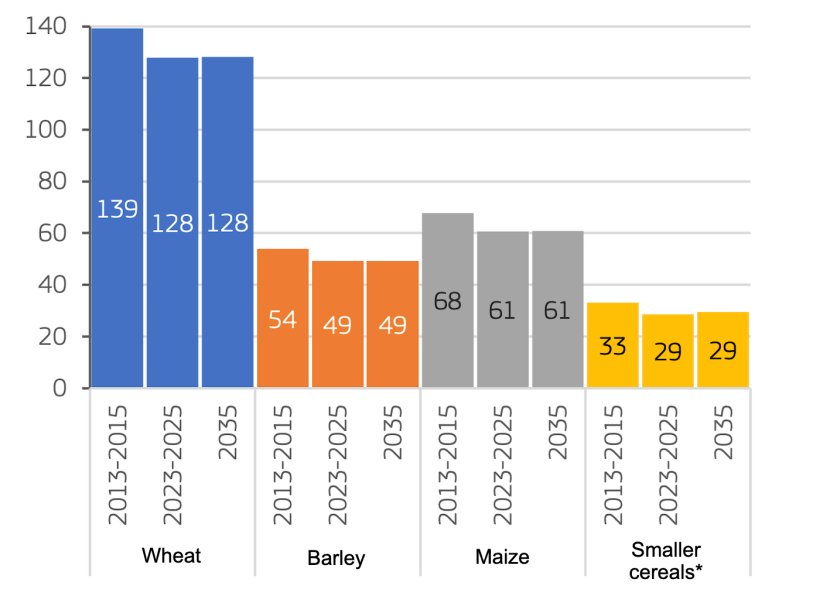
dedicated to wheat cultivation. Both soft and durum wheat production are projected to increase by 0.3% above their 2023-2025 level in 2035, at 120.6 million t and 7.5 million t, respectively, still well below 2013-2015 levels. Both maize and barley production are projected to remain stable at 60.8 million t and 49.2 million t, respectively. Apart from these major cereals, production of other, minor cereals, is projected to grow more strongly, rising by 0.3% per year by 2035, driven by oats. Oat production is expected to be 7.5% above 2023-2025 levels in 2035 because of growing demand, especially for food products.

Competitive EU exports
Net trade of cereals is expected to remain relatively unchanged between now and 2035. However, net trade of soft wheat and barley could continue growing, by 0.9% and 0.3% per year over the coming decade, respectively. Soft wheat imports are projected to decline between now and 2035 (-3.3% per year) due to greater domestic production in the EU, while maize imports could slightly increase (0.2% per year) as global availability improves. On cereals prices, between now and 2035 these are projected to increase at about 1.7% per year, influenced by higher fertiliser prices.
December 16, 2025/ European Commission/ European Union.
https://agriculture.ec.europa.eu